Practical guide
Render Test Panels: Choosing Colour and Texture
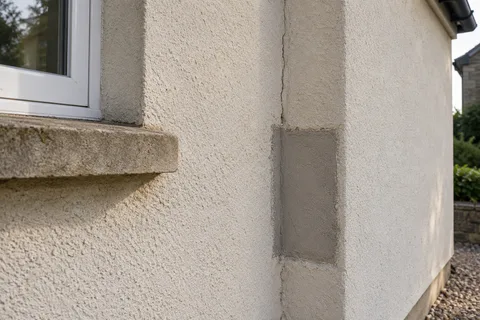
A test panel is a small area of the proposed render, made with the actual products and texture, so you can see the finish before a whole house or façade is done. K Rend recommends one for its systems, ideally about two square metres. Used well, it settles colour and texture; it cannot prove that the wall behind is ready, which is a separate question.

On this page
What a panel shows that a chart cannot
Colour charts and small samples are for indication; K Rend says so of its own. Render has texture, and texture throws tiny shadows that make the same pigment look darker on the wall than on a flat card. A panel shows colour and texture together, at a size where you can judge it from a normal viewing distance.
It can also show the details that matter: how the finish meets a bead at a corner, how a smooth reveal looks beside a scraped face, or how a repair edge sits against old render. What it cannot show is the whole elevation, with its pattern of windows and changing light, so judge the panel and the drawings together.
A panel made on a board shows the finish; a panel made on the wall also shows how the product behaves on that background. Both are useful, but approve each only for what it shows.


| Item | Why |
|---|---|
| Product and colour code | Identifies the exact option chosen |
| Texture or grain | Records the finish, e.g. 1.5mm or scraped |
| Background | Shows what the panel was made on |
| Date and light | When and how it was viewed |
| Approved by | One clear decision |
Why similar shades look different
Texture creates shadows that a flat colour chip does not show. A pronounced grain may look quite different close up from the way it appears across the garden. The angle of the surface and the surrounding materials add to that impression. This is why a decision about render colour should not leave texture unspecified until application begins.
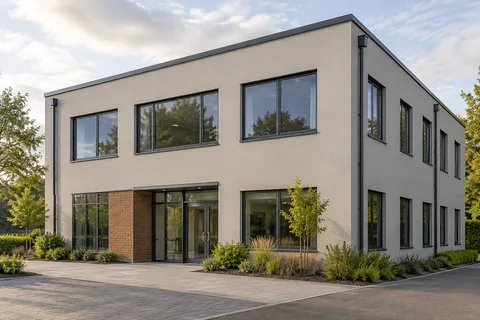
For example, a pale sample beside dark window frames may give a stronger contrast than the same sample photographed alone. A recessed return may appear different from the open wall even when the material is identical. These are ordinary aspects of viewing a façade, rather than proof of inconsistent product. The sample review should help the owner decide whether the appearance works in that setting.
Panels for different systems
Each system needs its panel made the way the real wall will be. A silicone topcoat panel should be laid over the same base coat and primer, at the same grain size, because K Rend's silicone finish is applied at the thickness of its largest grain and the grain sets the texture. A monocouche finish panel needs to be laid and then scraped at the right stage of set, because K Rend notes that scraping earlier gives darker shades and later gives lighter ones.
That makes a monocouche panel a test of timing as well as colour. If the panel was scraped the morning after and the main wall is scraped in the evening, they may not match.
Where to put it
Put the panel where it will be seen in the same context as the finished wall: beside retained brick, frames and the roof, on a face with ordinary daylight rather than deep shade. On a larger building with several very different elevations, a second panel may be worth having; on a house, one well-placed panel is usually enough.
Suppose a hypothetical end-terrace is being re-rendered in a pale silicone finish beside a red-brick neighbour. A panel on the gable facing the street, close to the shared corner, shows the colour in the light most people will see it in, and against the brick it will actually sit beside. A panel on the rear wall would answer a different question.
How to judge it
Let the panel dry and set fully before judging it; fresh render is darker than it will be. Look at it in the morning, in the afternoon, after rain and in dry weather, from close up and from where you normally see the house. Make notes about what you see, such as too coarse close up, or too yellow beside the frames, so the next panel can be adjusted rather than chosen at random.
Keep the shortlist short. Several panels in near-identical creams quickly become confusing; label each with its product and colour code rather than names like the second cream.
One decision, one person
If several people have a say, look at the panels together and agree one choice. On a commercial building that might be the owner and the designer; on a house, the household. Record the approval in writing with the product, colour code, grain or texture and date, so the team doing the main work has a single reference.
What approval does not cover
Approving a panel approves its appearance. It does not confirm that the wall behind the main work is sound or ready; that comes from tapping, repairs and the checks the system requires. If making the panel reveals a problem, such as the background drawing water too fast or the old render sounding hollow, deal with that before going further.
Nor does a panel promise that a repair will vanish against weathered render. Where the work is a repair, agree how close a match is realistic.
Panels can also mislead if they are not representative. A panel trowelled by the most experienced person on a sheltered wall in ideal weather may look better than the main elevation applied in a hurry on a breezy day. Ask that the panel is made the way the main work will be made, by the same team, with the same mix and method, and that the main wall is checked against it as work proceeds rather than only at the end.
Keeping the reference
Keep the panel, if it is on a board or a wall that is not being covered, until the job is finished, and photograph it with its label. The approved reference then becomes part of the record for future repairs. The Rotherham rendering homepage links the finishes a panel might be choosing between.
Common questions
How big should a test panel be?
Big enough to judge texture and colour from a normal viewing distance. K Rend's instructions suggest ideally about two square metres for its products, prepared well before the main work, which is far more useful than a hand-sized sample.
Can the test panel be part of the finished wall?
Sometimes, if it is made on an area that will be finished in the same system and is accepted. Often it is made on a board or on a wall that will be covered later, so it can be adjusted or discarded without leaving a patch in the final work.
See housing and planning information for Rotherham and nearby places, including the source and geography behind each figure.