Render repairs
Render Repairs Rotherham: Cracks, Hollow Render, Subsidence
Render fails locally long before it fails everywhere: a crack below a window, a bulge where water has got behind, a corner knocked off by a ladder, a band at ground level that never dries. Repairing it well means finding the edge of the damage, dealing with the reason it happened and rebuilding the patch so it lasts. In a former mining area it also means asking what caused a crack before filling it.

On this page
Finding the edge of the damage
Sound render rings when tapped; render that has come away from the brick sounds dull and hollow. SPAB describes removing hollow-sounding patches as a sensible partial repair, and the tap test is how they are found. Chalk round the hollow area and the true size of the repair becomes clear; it is often larger than the crack on the surface.
Look for the water. K Rend's design guidance points to the usual culprits: sills and copings without a projecting drip, gutters and downpipes that let water run down the face, and render taken down over the DPC. A repair beneath a leaking downpipe joint will fail in the same place, so fix the pipe first.
- Map the damage Tapping finds hollow areas; cracks and their likely cause are noted.
- Cut back Failed render is cut out to a sound edge, usually squared off.
- Fix the cause Leaking gutters, sills without drips or render below the DPC are dealt with.
- Rebuild in coats Using a material compatible with the surrounding render and masonry.
- Blend the finish Texture is matched; colour may need a coating over the wider area.
The usual order of work. The survey and the chosen products decide the actual steps.
Cracks in a coalfield area
Fine crazing and short cracks at the corners of openings are common shrinkage and movement in render. Wide, stepped or lengthening cracks, especially with doors or windows starting to stick, can point to movement in the building. GOV.UK says coal mining subsidence can begin with problems such as cracked plaster and sticking doors, and that a chartered surveyor can establish whether damage is due to coal mining.
If mining could be the cause, the GOV.UK guide to subsidence rights says claims must be made within six years of the damage becoming apparent, and that normally no repairs should be arranged until the mine owner has been consulted, apart from urgent work to stop further damage, which you should report as soon as possible. Claims now go to the Mining Remediation Authority; the 2019 guide itself refers to the Coal Authority. Photograph the cracks, with a date, before anyone fills them.
Rebuilding the patch
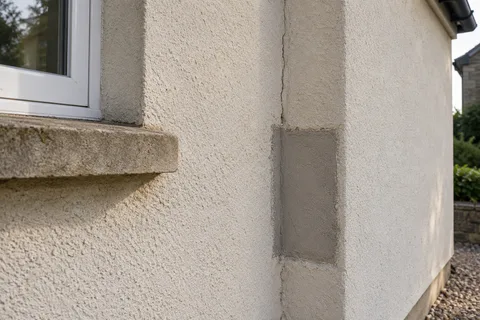
The failed render is cut back to firm material with straight edges, and the brick beneath is cleaned and repaired. Absorbent masonry is dampened so the new mix is not dried out by suction. The patch is then built in the same layers as the original, a base coat keyed and left to firm, then the finish, so it ends flush with the wall around it.
Match the material as well as the layers. A cement patch in a lime render is harder and less permeable than its surroundings; on older walls, SPAB favours lime mixes with a hydraulic set for this kind of patching.
Tap-test and chalk the hollow and cracked areas; photograph and date them.
If cracks could be subsidence, get a chartered surveyor's view before repairing.
Fix the water source: sill drip, gutter, downpipe or render over the DPC.
Cut back to sound render and repair the masonry beneath.
Rebuild in matching coats, keying and curing each one.
Blend the finish, recolouring to a corner or downpipe where needed.
A one-off patch or a planned repair programme
For a homeowner, a repair is usually a day or two on a ladder tower or small scaffold. For a landlord with many houses, the same defects tend to repeat: cracked sill ends, blown render at the base of walls, failed patches round old pipe holes. Recording each repair with a photograph, a date and the materials used makes it easier to see whether the cause has been fixed or the same crack keeps coming back.
For example, on a hypothetical 1950s semi with a crack running up from a bedroom window head, the repair would start by checking whether the crack is widening and whether the window now sticks. If it is stable and fine, the render either side is tapped, the hollow area cut out and rebuilt. If it is widening, the crack is photographed, dated and left until a surveyor has looked at the cause.
Common questions
Will the repaired patch show?
Often a little. Fresh render differs in tone and texture from weathered render, and through-coloured monocouche is the hardest to blend. Painted render can be repainted to a natural break so the patch disappears; otherwise accept a slight difference or plan a full [respray](/respray/) of the elevation.
Can I fix a leaking gutter before a subsidence claim is settled?
The GOV.UK guide allows urgent work needed to prevent further damage, as long as you tell the mine owner what was done and why as soon as possible. Stopping water pouring down a cracked wall is the kind of work that can usually be justified; re-rendering the cracked area is not.
See housing and planning information for Rotherham and nearby places, including the source and geography behind each figure.