Pebbledash removal and replacement
Pebbledash Removal Rotherham: Strip, Repair or Re-dash
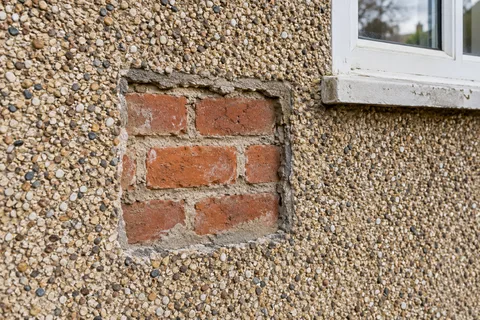
Pebbledash is a cement render with stones pressed into its face. When it starts to sound hollow, crack or drop stones, it can be stripped and replaced with a new render, or the wall can be dashed again. On semis and terraces the neighbour's dash usually stays, so the job has a visible edge as well as a technical one.

On this page
How dash is put on, and so how it comes off
K Rend's instructions describe two dashed finishes. For dry dash, a base coat of 8-10mm is followed by a butter coat about 8mm thick, and while it is still plastic, washed aggregate is thrown at it and tamped in lightly with a float. For roughcast, a wet mix with the stones in it is thrown on with a dashing spoon over a dash receiver of about 6mm. Either way, there are at least two layers of cement render to break off, and the stones make the debris heavy and sharp.
SPAB's warning about cement removal applies here: lever off large sheets and you can pull the faces off soft bricks. Careful work with hammer and bolster, starting with a trial patch on each wall, shows how well the dash is stuck and what condition the brick is in.
- Trial area A small patch is taken off to see how well the dash is bonded and what lies beneath.
- Removal Dash and backing render are hacked off to masonry or to a sound backing coat.
- Clear and dispose Debris is bagged or skipped; this is heavy, dusty and noisy work.
- Repair the masonry Exposed bricks, blocks and joints are repaired before anything new goes on.
- New render system The wall is rendered with the chosen system, or left as fair-faced masonry if suitable.
The usual order of work. The survey and the chosen products decide the actual steps.
Strip, overcoat or keep
Dash that sounds solid all over can stay. It can be painted, or a base coat can level it for a smooth finish. Strip it when large areas sound hollow, when it bulges or sheds stones, or when it runs over the DPC to the ground and keeps the base of the wall wet. On a semi, stripping your side while the neighbour's stays is common sense if your dash has failed and theirs has not; the edge is formed with a stop bead on the party line.
If you want the house to keep matching next door, the new finish can itself be a dash. K Rend's roughcast guidance says to mix enough material for the whole area at once and not to go back over half-set areas to fill misses, because both cause patchy colour; matching an older neighbour's stones exactly is still unlikely.
A semi and a street
For one owner-occupier, the practical questions are access through a narrow side passage, where the debris goes, and how the party-line edge will look. When a landlord strips a whole row under one contract, the work moves along the terrace a house or two at a time, and the stripped walls are recorded as they are exposed, because the brickwork behind identical-looking dash can differ from house to house, with old openings and repairs.
In either case, after stripping, joints are raked and repointed, spalled bricks replaced and hollows dubbed out. A wall left wet by failed dash is allowed to dry before it is rendered again.
Tap-test each wall and agree which faces are stripped.
Plan scaffold, sheeting, debris routes and the party-line edge.
Hack off a trial patch, then strip dash and base coat from the top down.
Record the exposed brickwork and any old openings or repairs.
Repair joints and bricks; let the wall dry.
Fix a bell-cast bead above the DPC and stop beads at the edges.
Apply the base coat, then a new render finish or a new dash.
After the dash has gone
The new system stops above the DPC on a bell-cast bead, which K Rend's guidance asks for so render does not create a damp route at the base. If you hoped for bare brick, look hard at the trial patch first: brick that was hacked to key the dash, mixed with patch repairs, may need a new render anyway. Keep photographs of the stripped wall for the house file.
Removal is noisy and dusty. Tell attached neighbours when it will happen, keep their windows and vents sheeted, and agree where the scaffold stands if it has to cross the boundary. The debris from one elevation of dash and backing coat can fill a skip, so the skip position, a permit if it sits on the road, and a safe route for barrows all need settling before work starts.
Common questions
Will removing pebbledash cause cracks inside the house?
Careful hand removal should not, but heavy breakers on a weak wall can disturb plaster or loose bricks. Starting with a trial area shows how the wall responds. Report any internal cracking straight away so the method can be changed.
Can new pebbledash be applied over old pebbledash?
Not over loose or hollow dash. If the old dash is sound, it can sometimes be levelled with a base coat and dashed again, but any hollow areas have to be cut out first, because a new coat on failing dash fails with it.
See housing and planning information for Rotherham and nearby places, including the source and geography behind each figure.