Practical guide
Matching an Extension’s Render to the Original House
An extension can share the look of the original house without sharing its wall build-up. The usual choice is between a close match, a related finish and a deliberate contrast. This article explains what each involves, why exact matches are hard, and how the junction between old and new should be formed whichever you choose.

On this page
What match actually means
Match can mean the same colour, the same texture, or the same overall look across the whole elevation. An extension can repeat the house colour yet look different because its texture, window sizes and proportions differ; it can use a related shade in a similar texture and still read as one building. Decide which of those you are after before any samples are made, because each points to a different finish.
Weathering complicates the target. A rendered house that has stood for twenty years will be paler where the sun hits and darker or greener where it does not, so there may be no single colour to copy. Pick one reference area, usually the wall that will be seen beside the extension, and accept that the new finish will look fresher for a while.
Rotherham's householder design guide, adopted in October 2025, covers extensions generally. It does not choose a render for you, but it is worth reading before the design is fixed.

| Approach | What it involves |
|---|---|
| Close match | Same render type and colour, sample beside the house |
| Related finish | Same colour family, different texture or system |
| Deliberate contrast | Different finish with a clean bead at the junction |
| Recolour both | Extension rendered, sound house render resprayed to suit |
Matching each kind of existing render
The existing finish decides what is realistic. A painted sand-and-cement house is the easiest: the extension can be rendered in sand-and-cement or a base coat and painted the same colour, and the house can be repainted at the same time so both are fresh. A through-coloured scraped render is harder, because shade varies between batches and with scraping time, so a new wall in the same product will rarely match an old one exactly.
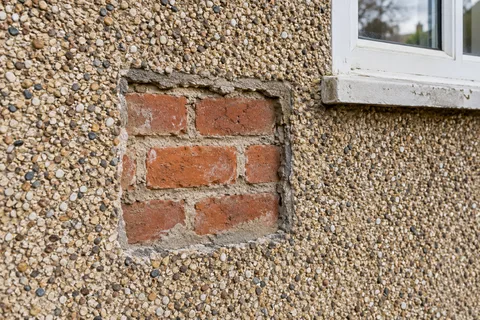
Pebbledash is the hardest. Matching the size, colour and density of old stones is seldom possible; a new dash on the extension usually reads as new for years. Many owners choose a smooth or scraped render for the extension instead, as a deliberate contrast, or include the original house in the refurbishment and recoat both. That brings the older walls into the job and they need their own survey; their condition, not the extension, decides what they need.
Brick houses are a separate case. A rendered extension on a brick house is almost always a contrast, and the choice is about which render colour sits well with the brick, roof and frames.
The junction between the two
However well the colours match, the extension and the house are two structures. New blockwork shrinks as it dries and the extension settles on new foundations, so render carried straight across the joint will crack. A stop bead or movement joint at the internal corner gives a straight, controlled line where any movement can happen.
Look at levels as well. The extension's damp-proof course may not line up with the house's, and the render on each part should stop above its own DPC on a bell-cast bead. Where an extension roof abuts the house wall, a flashing should lap over the render so water cannot run behind it.
Samples beside the house
A sample applied to the extension wall, in the actual product, texture and colour, tells you more than any chart; K Rend recommends a site sample panel because its colour samples are for indication only. Place it where it can be seen alongside the house, and look at it from the garden and the street as well as close up.
Review it in different light, morning and afternoon, dry and after rain. Narrow the choice to two or three and record the one you approve with its product and colour reference, so there is no doubt later which sample was chosen.
Windows, sills and roof edges
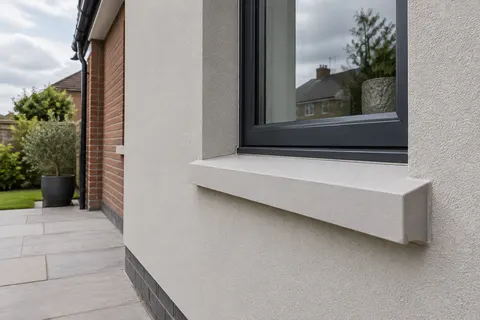
Give the renderer the final window and roof-edge details. Sills on the extension should project with a drip so rain clears the new render, and reveals need beads to give a straight edge to the frames. If the extension windows are a different style from the house, the render returns around them will look different too, which affects how close the overall match appears.
When recolouring the house is the better answer
If the house render is sound but weathered, the simplest way to make old and new agree may be to render the extension and then respray the house in the same colour. That is extra work with its own preparation: cleaning, algae treatment and repairs to the house render before it is coated. Treat it as a separate, optional item, and ask whether the house render taps sound before you commit.
Suppose a hypothetical semi with cream painted render, faded and green on the shaded side, gains a rear extension. Rendering the extension in a fresh cream and repainting the whole house afterwards would give one consistent colour; rendering the extension alone would leave a clean new wall beside an older one, which some owners prefer.
Phasing the work
If the extension is finished now and the house later, finish the extension properly: beads at the junction, drips on sills and the base clear of the DPC. Keep the product name and colour reference, and accept that a house finished years later will be compared against an extension that has itself weathered. The same colour code will not give the same appearance on walls of different ages.
The completed record
Photograph the junction before and after it is covered, and keep the specifications for both parts of the building, including any differences in preparation. That record explains why the same-looking finish covers different walls. If the survey points to work on the house itself, the Rotherham rendering homepage links each of the services involved.
Common questions
Can new pebbledash on an extension match old pebbledash on the house?
Rarely exactly. The stones, their density and the weathering of the old dash are difficult to reproduce. A deliberate contrast, or recoating both parts in the same colour, usually gives a more convincing result than chasing an exact match.
Should the extension be rendered before or after the house is recoloured?
Render the extension first and let it cure, then recolour the house and, if wanted, the extension in one coating campaign. Doing it that way round means both surfaces receive the same coating at the same time, which gives the best chance of an even colour across old and new.
See housing and planning information for Rotherham and nearby places, including the source and geography behind each figure.