Practical guide
Rendering an Older Stone or Brick Outbuilding
Old outbuildings, from stone barns to brick wash-houses and garages, are often single-skin walls with no damp-proof course, ground built up against them and roofs that drip straight onto the masonry. Rendering one can protect it, but the wrong render can trap water and speed its decay. This article explains what to check and which materials suit.

On this page
A render coat is not a conversion
If you plan to turn an outbuilding into a workshop, office or room, the render is one part of a bigger project that may need its own design and approvals. New render on the outside does not make a cold, damp single-skin building suitable for living or working in. Treat the render as weather protection and repair, and deal with the building's use separately.
Even a small outbuilding can have a lot of edges: doors, windows, a roof verge on each gable, corners and a wall base that may sit below the surrounding ground. Each one needs a detail, and they matter more than the size of the wall.

| Check | Why it matters |
|---|---|
| Wall material | Stone and soft brick usually need lime |
| Ground level | Soil against the wall keeps it wet |
| Roof and gutters | Water pouring down the face defeats any render |
| Existing coating | Cement may need careful trial removal |
| Location | Conservation area or listed setting |
Lime or cement for old masonry
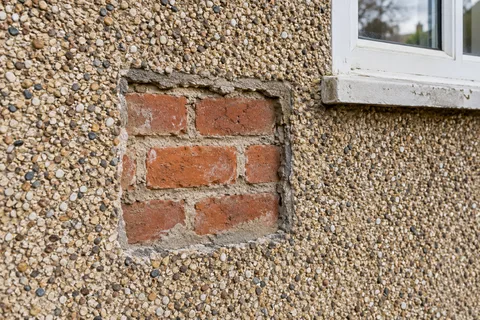
Old stone and soft brick walls were built to absorb rain and dry out. SPAB explains that cement render on such walls restricts drying, cracks finely because it is more rigid than the wall, and lets water in that then cannot escape. It recommends a weaker, more permeable lime render without cement, applied by someone used to lime.
Lime is not chosen because a building looks rustic, but because the wall works that way. If the outbuilding is of hard modern brick or block, a cement-based render may be perfectly suitable; if it is stone or soft old brick, lime is usually the better match. Where an old cement coat is already in place, SPAB suggests a trial area before removing it, because removal can damage the wall, and leaving well-stuck render to age if it is not causing harm.
The base of the wall
Many old outbuildings have no DPC, and garden soil, gravel or paths have often been built up against them. Lowering the ground so the wall base is exposed and can dry is often the single most useful repair, and render should not be carried down into the soil. Lime render at the base will still get wetter than the rest and may need patching sooner; that is normal for a breathing wall.
Roof edges and water
Check the roof before rendering. A missing gutter, a slipped verge or a roof with no overhang will pour water onto the new render every time it rains. Fix the roof edge first, or at least add a gutter and make sure it discharges away from the wall. Over timber lintels, Mike Wye's lime guide counter-battens the timber and laths it rather than rendering directly onto wood.
How lime goes on
Mike Wye's guide for its mortars shows the usual build-up. Deep holes are packed with haired lime mortar, the wall misted before each coat, a thin harl coat of about 3mm thrown on, then a 15mm haired scratch coat combed for a key, then a 10mm float coat, each left to go green hard before the next. On exposed elevations the guide adds pozzolan for a harder, more frost-resistant render. Limewash finishes it, typically four coats, renewed every few years.
Protection and timing
Lime cures slowly, taking carbon dioxide from the air over months. Each coat needs shading from sun and wind, cover from rain, damp hessian in dry weather, and no work below 5°C where frost is possible. On an outbuilding that often means a temporary scaffold sheeted for several weeks, and planning the job for the warmer part of the year.
Permission and setting
Rotherham has 28 conservation areas, mapped on the council's planning maps. Outbuildings in a conservation area, or within the grounds of a listed building, may need consent before their appearance is changed; Historic England's guidance on permission for changes to older homes explains the main routes. Check before rendering a stone building that has been bare for decades, because the change in appearance can be significant.
A worked example and common failures
Take a hypothetical stone outbuilding with a cracked cement render, damp at the base and a sagging gutter. A trial area at the base shows the cement coming away easily and the stone behind soft and wet. The plan becomes: fix the gutter and lower the soil along the wall; remove the cement render carefully by hand; let the wall dry over a few weeks; repoint decayed joints in lime; then apply a three-coat lime render and limewash, all in late spring and summer.
The failures to avoid are the familiar ones. Cement patches put into a lime wall stay hard while the lime around them weathers, and moisture concentrates at their edges. Lime laid in cold weather or left unprotected in hot sun can fail before it has hardened. Render carried down into soil stays wet. And a new render without the gutter fixed will be streaked and damp again within a year.
SPAB also warns that salts from years under cement can come out through new lime. White deposits or small areas of breakdown in the first couple of years can be part of that process, and local re-rendering may be needed.
Records and care
Photograph the walls before and after, note the lime products and mixes used, and keep the limewash details for recoating. If a defect appears later, the record shows what was done and with what. The Rotherham rendering homepage links the lime, wall and removal services for buildings of this kind.
Common questions
Can I render the inside of an outbuilding instead?
Internal plastering and lining are outside the scope of these pages. On the outside, the key point is that render on old masonry should let it dry; trapping damp with a hard outer coat can make the inside wetter, not drier.
Should an old stone outbuilding be rendered at all?
It depends on its history and condition. SPAB notes that many old buildings were rendered originally or later for weather protection, and that leaving a wall bare after removing render is usually a mistake. A stone building that has stood bare and sound for a long time may not need render; one with soft, eroding stone and damp inside may benefit from lime.
See housing and planning information for Rotherham and nearby places, including the source and geography behind each figure.